 160 m
160 mAbout
"Mashenka": A New Restaurant of Modern Russian Cuisine by Alexander Rappoport
In February 1926, Vladimir Nabokov signed a contract with a publishing house to publish the novel "Mashenka." A century later, on February 5, 2026, Alexander Rappoport opened a restaurant of modern Russian cuisine in Moscow called "Mashenka." This new project continues the conversation about Russian gastronomy as a living, relevant, and everyday cuisine, one that does not require historical reconstructions.
For a long time, Russian cuisine existed either as a museum piece, a source of nostalgia, or an object of gastronomic experiments. "Mashenka" offers a different approach: restaurant-quality cuisine, free from clichés and ostentatious complexity.
"Modern Russian cuisine – there's a lot of talk about it these days, although no one really understands what it is," – this thought became the starting point of the project. For Alexander Rappoport, Russian cuisine is not a trend or a genre, but a natural gastronomic foundation that is considered the norm in any country. Italians don't discuss whether they will go to an Italian restaurant today, and the French – to a French one.
The idea for the project arose from the feeling that the gastronomic pendulum had made a full circle. After decades of fascination with foreign flavors, complex constructions, and demonstrative gastronomy, it became clear that people are still interested in trying new things, but it is even more important to return to what is truly close and familiar. Not out of fatigue or nostalgia, but out of a desire to eat food with its own cultural code.
The name "Mashenka" was chosen for a reason. It is a soft, recognizable Russian name and also a reference to the novel of the same name by Vladimir Nabokov. This image resonated with the project: it is not about recreating the past, but about returning to feelings and tastes that do not lose their intensity over time.
The chef, Igor Grishchekin, is responsible for the cuisine in the restaurant. He is one of the key figures in modern Russian gastronomy. His name is associated with thoughtful work with local and seasonal products, recognizable flavors that are free from direct quotations. After many years of working in St. Petersburg and a period of inactivity that was closely followed by the gastronomic community, his arrival in the Moscow project is a significant event.
Igor Grishchekin offers an author's interpretation of Russian cuisine, without Olivier salad or Chicken Kiev, but with a clear Russian DNA. The menu is structured as a collection of familiar flavors, brought to restaurant-level precision. Crabs are made into real sausages and served with bisque sauce and mashed potatoes, cabbage rolls are transformed into miniature "cabbage rolls" made with Brussels sprouts, crab meat, caviar sauce, and potato mousse, and coriander is added to the tiramisu in the style of Borodino bread. The classics are not reproduced literally, but reinterpreted. The menu has more than 60 items, and it looks compact, but creates a feeling of abundance, which is important for the Russian gastronomic tradition.
The bar is an extension of the overall gastronomic concept. It is based on a symbiosis with the kitchen: familiar flavors, local ingredients, and familiar products, revealed in an unexpected way. For example, the head bartender, Alexandra Vodnitskaya, uses beets and roasted pumpkin, which are common in Russian cuisine, but rarely found in cocktails. The cocktail menu is inspired by butterflies – Vladimir Nabokov was not only a writer but also a professional lepidopterologist, a specialist in butterflies.
A special emphasis is placed on Russian strong drinks – samogon, kvass wine, and semi-fermented beverages, which serve as the basis for both classic and author's combinations.
The wine list consists entirely of Russian labels. This is a conscious position of the project and part of the overall concept developed by Alexander Rappoport: if the restaurant talks about modern Russian cuisine, then the wine should also continue this theme. The head sommelier, Elena Kapanele, is responsible for creating the wine list. The menu is structured geographically and covers almost the entire country. It includes more than 100 items, featuring both small, rare producers and independent wineries, as well as well-known and established names.
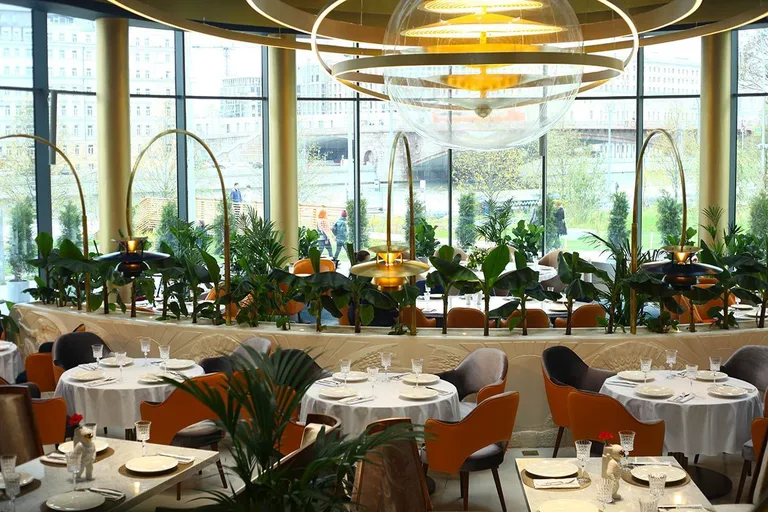
The interior of the restaurant continues the same logic. The space is filled with references to Russian culture, but without direct illustration. The design project was developed by the architectural firm ARCHPOINT. The space is a modern interpretation of Russian culture, with meticulous attention to images and details. One of the dominant features is a wall with portraits of "Mashenkas," created by Moscow artists specifically for the project and hung in the style of a gallery exhibition, as in the Hermitage. They are all real heroines from different eras who have left their mark on history, and they are all united by the name Maria. The paintings are slightly veiled with a thin metal mesh – a gesture that removes the directness and adds distance and mystery to the images.
The interior reinterprets motifs of folk crafts, imperial Russia of the 19th century, and literary allusions, which are noticeable in the details of the space – all of this is combined into a calm, ironic, and cohesive space. Among the details are a Russian braid as a graphic element, antique samovars, a real oven in the center of the kitchen, and a "protection from jerks" in a frame – a joke for attentive guests.
Gallery
Current brigade
No brigade recorded yet.
DINER REVIEWS
Reviews
No reviews yet. Be the first to share your experience.
Nearby
Closest Restaurants
160 m 280 m
280 m 300 m
300 m 400 m
400 m